
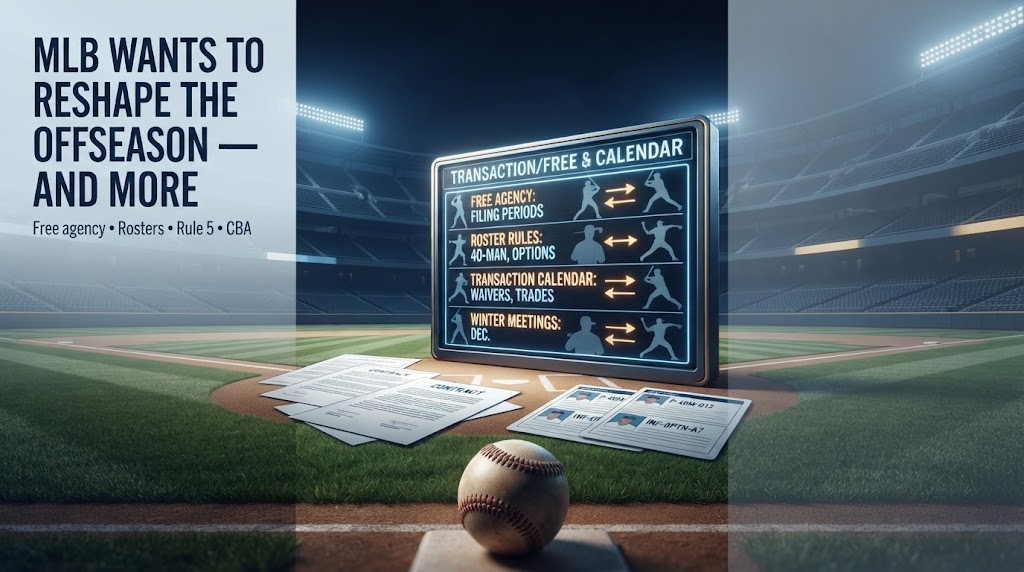
Major League Baseball has proposed sweeping changes to free agency, roster rules and player movement as CBA negotiations continue. Here’s what could change—and why players are pushing back.
By Sports UNIllustrated
August 28, 2026
What could change:
- • Free-agent signing windows
- • Weekly roster setting
- • Injured-list minimums
- • Minor-league options
- • Rule 5 Draft eligibility
- • Salary-cap/payroll-floor proposal
Major League Baseball is proposing some of its biggest changes to player movement and roster management in years.
The league’s latest proposal to the MLB Players Association would change when free agents can sign, how often teams can alter their rosters, how injured-list stints work, how many times players can be optioned to the minors and when players become eligible for the Rule 5 Draft.
The proposals are part of the ongoing negotiations for a new collective bargaining agreement. The current CBA expires December 1, and one of the central disputes remains MLB’s push for a salary cap and payroll floor.
So what exactly is MLB proposing?
A New Calendar for Free Agency
Perhaps the most noticeable change for fans would be a restructuring of the free-agent period.
Under MLB’s proposal, free-agent activity would be concentrated into defined windows rather than continuing throughout the offseason.
The first window would begin around the start of the Winter Meetings in December and run through December 21. A second window would open in February. Under the proposal, a quiet period would precede the December window, while a frozen period from December 21 until the first Monday in February would prohibit transactions involving Major League players.
The idea is to create a concentrated period of activity—essentially giving baseball its own version of the transaction frenzies fans see in the NFL and NBA.
For fans, that could mean a very different offseason.
Instead of major signings trickling out over several months, teams could be forced into a much more compressed period of decision-making.
But the MLBPA sees a serious downside.
MLBPA interim executive director Bruce Meyer has argued that an artificial free-agency window could reduce players’ leverage and create a situation where players compete against one another for a limited number of available opportunities.
Weekly Rosters Could Change How Teams Manage Players
The proposal also calls for teams to establish their rosters on a weekly basis, with rosters set each Monday.
After that point, changes would generally be limited to situations such as injuries, trades, waivers, bereavement and paternity leave.
That could significantly change the way clubs manage their players.
Baseball has become increasingly reliant on roster flexibility, particularly with pitchers moving between the majors and minors and teams constantly adjusting their bullpen and bench.
A weekly roster system could provide more stability—but it could also take away some of the flexibility teams have become accustomed to.
The Injured List Could Change, Too
MLB is also proposing shorter minimum injured-list periods for certain players.
Under the proposal, the current 10-day minimum for position players would become one week, while pitchers would have a two-week minimum. The current 60-day injured list would also be replaced with a 12-week minimum, while existing 40-man roster exemptions would remain.
That’s a significant change because injured-list decisions aren’t simply administrative. They can affect roster construction, player development and how quickly a team can get a contributor back on the field.
Fewer Minor-League Options
Another proposed change would reduce the number of annual optional assignments a player can receive from five to four.
In practical terms, teams would have fewer opportunities to move certain players between the majors and minors without exposing them to the waiver process.
That could make roster decisions more consequential—and potentially create more opportunities for players who otherwise might spend extended periods bouncing between levels.
Rule 5 Draft Changes
MLB also wants to move Rule 5 Draft eligibility up by one year.
The league is proposing that players selected in the Rule 5 Draft could also be optioned to the minor leagues, a change from the current system in which a Rule 5 selection generally has to remain on the major-league roster for the season or be exposed to the waiver process.
For organizations with deep farm systems, that could have major implications for how they protect and develop prospects.
The Bigger Issue: Money
There’s a reason these proposals shouldn’t be viewed separately from MLB’s larger labor negotiations.
Many of the league’s proposed changes are tied to its push for a salary cap and payroll floor.
MLB has argued that payroll disparity has created competitive-balance problems and that a cap-and-floor system could give more clubs a realistic opportunity to compete. MLB’s earlier proposal called for a $245.3 million payroll cap and a $171.2 million floor.
The MLBPA opposes a salary cap, arguing that limiting payroll would restrict the free market and players’ earning power.
That means the proposed transaction changes aren’t happening in isolation.
They’re pieces of a much larger fight over what the next era of Major League Baseball should look like.
What Would This Mean for Fans?
That’s where things get interesting.
There are obvious potential benefits.
A concentrated free-agency period could create an offseason event fans actually plan around. Instead of checking transaction feeds every day for months, fans could get a few weeks of intense activity.
Weekly roster rules could create greater stability.
Earlier Rule 5 eligibility could potentially help prospects reach the majors sooner.
And changes to the injured list could give teams more flexibility when dealing with injuries.
But there are legitimate questions, too.
Would restricting free agency actually create more excitement—or simply make it harder for players to maximize their value?
Would weekly roster rules improve stability or make it harder for teams to react?
And most importantly, does tying these changes to a salary cap make the overall proposal a better deal for baseball—or a better deal for ownership?
Those questions won’t be answered by MLB alone.
The MLBPA still has to agree.
The Bottom Line
Major League Baseball isn’t proposing one small offseason adjustment.
It’s proposing a different way of managing the sport.
Free agency could become more concentrated. Rosters could become more stable. Injured-list rules could change. Players could have fewer minor-league options, and Rule 5 prospects could have a different path to development.
But all of it is connected to the larger battle over baseball’s economic system.
With the current CBA set to expire December 1, these negotiations are worth watching closely—not just because of what happens this winter, but because the decisions being made now could shape how baseball operates for years to come.
What do you think?
Would a more concentrated free-agency period make MLB’s offseason more exciting for fans—or would it take away too much freedom from players?


Leave a comment